
 Back to blog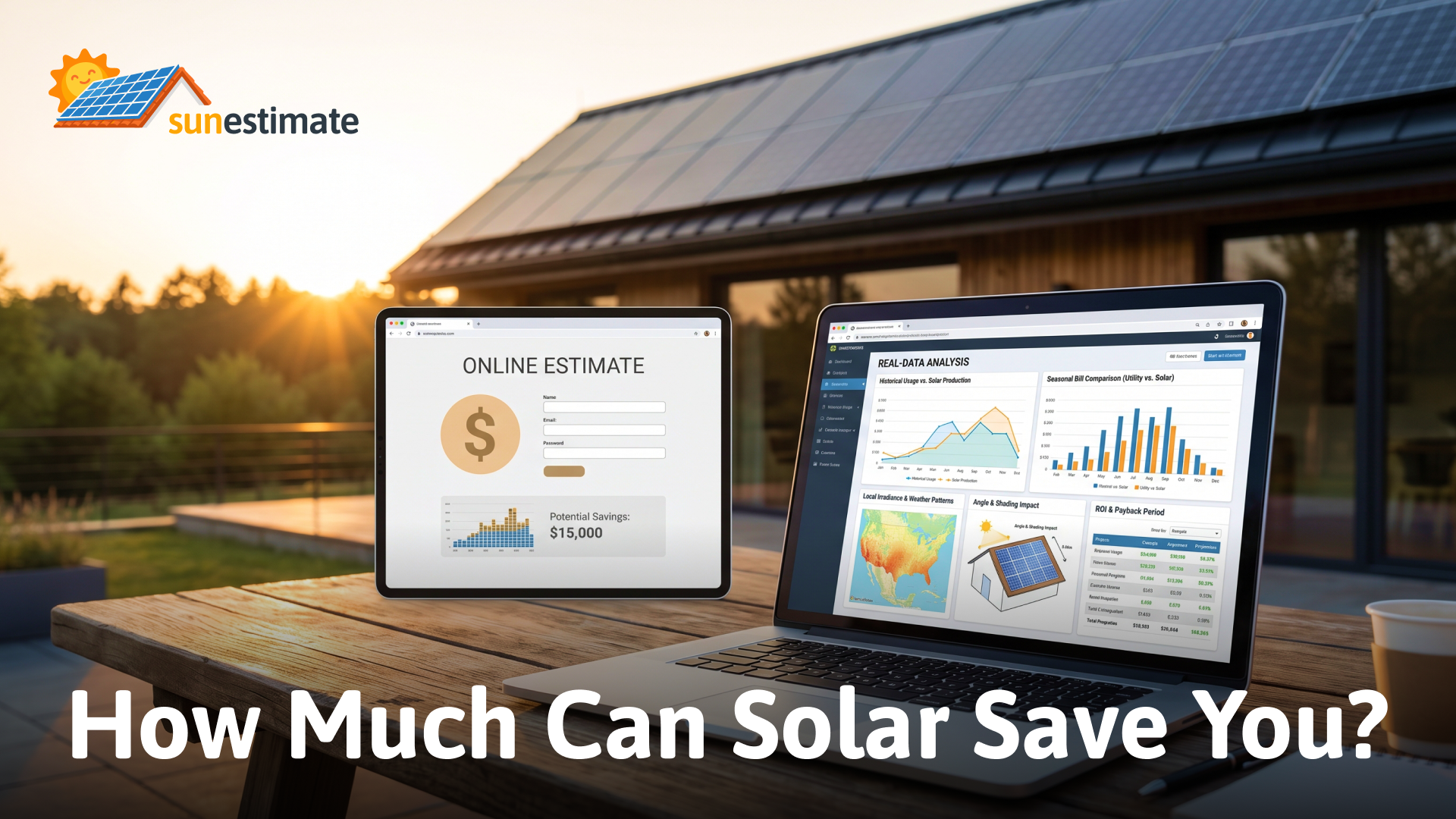
A solar savings calculator —sometimes called a solar estimate calculator, solar panel savings calculator, or solar energy savings tool— gives you a way to estimate how much electricity a solar system could generate, how much it could reduce utility bills, and how long it may take to recover the investment.
Not all calculators are created equal, though.
Many rely on broad statewide averages instead of analyzing the details that truly determine a home's solar potential. Understanding the inputs behind an estimate is just as important as the savings number itself.
Key Findings Summary
A solar savings calculator estimates your bill reduction using your actual roof, location, and energy use — not generic averages.
California's electricity rate hit 35.25¢/kWh in April 2026 (EIA) — nearly double the national average, making solar more valuable here than almost anywhere else.
Most free calculators use ZIP code averages instead of real roof data, producing estimates that can miss by a wide margin.
A calculator built on your actual roof and utility bill helps you decide wisely before any installer gets involved.
What Is a Solar Savings Calculator?
At its simplest, a solar savings calculator is an online tool that estimates how much money a homeowner could save by installing residential solar panels. Rather than providing a formal installation quote, it combines your address, roof characteristics, energy usage, and local utility rates to model what a solar system would realistically produce and save.
The core output typically includes:
an estimated amount of electricity the system would generate,
a monthly savings range,
an approximate system cost,
and a payback period — the number of years before your accumulated savings equal your upfront investment.
How Solar Calculators Work
Most online calculators run on a nearly similar logic.
First, they estimate the home's annual electricity consumption. Some ask homeowners to enter their monthly electric bill, while others estimate usage based on ZIP code averages. The calculator then:
evaluates how much solar energy a properly sized system could generate under local weather conditions;
combines estimated production with local electricity rates to project annual savings and, in many cases, the expected solar payback period.
On the one hand, many reputable calculators also rely on solar production models developed by the National Renewable Energy Laboratory (NREL), including PVWatts, one of the industry's most widely used solar performance calculators.
On the other hand, some advanced tools estimate battery storage performance, projected utility bill reductions under California's current net billing rules, financing scenarios, and long-term energy production.
What Affects Your Savings Estimate?
A solar estimate calculator is only as accurate as the information it receives. Several variables significantly influence the final savings estimate.
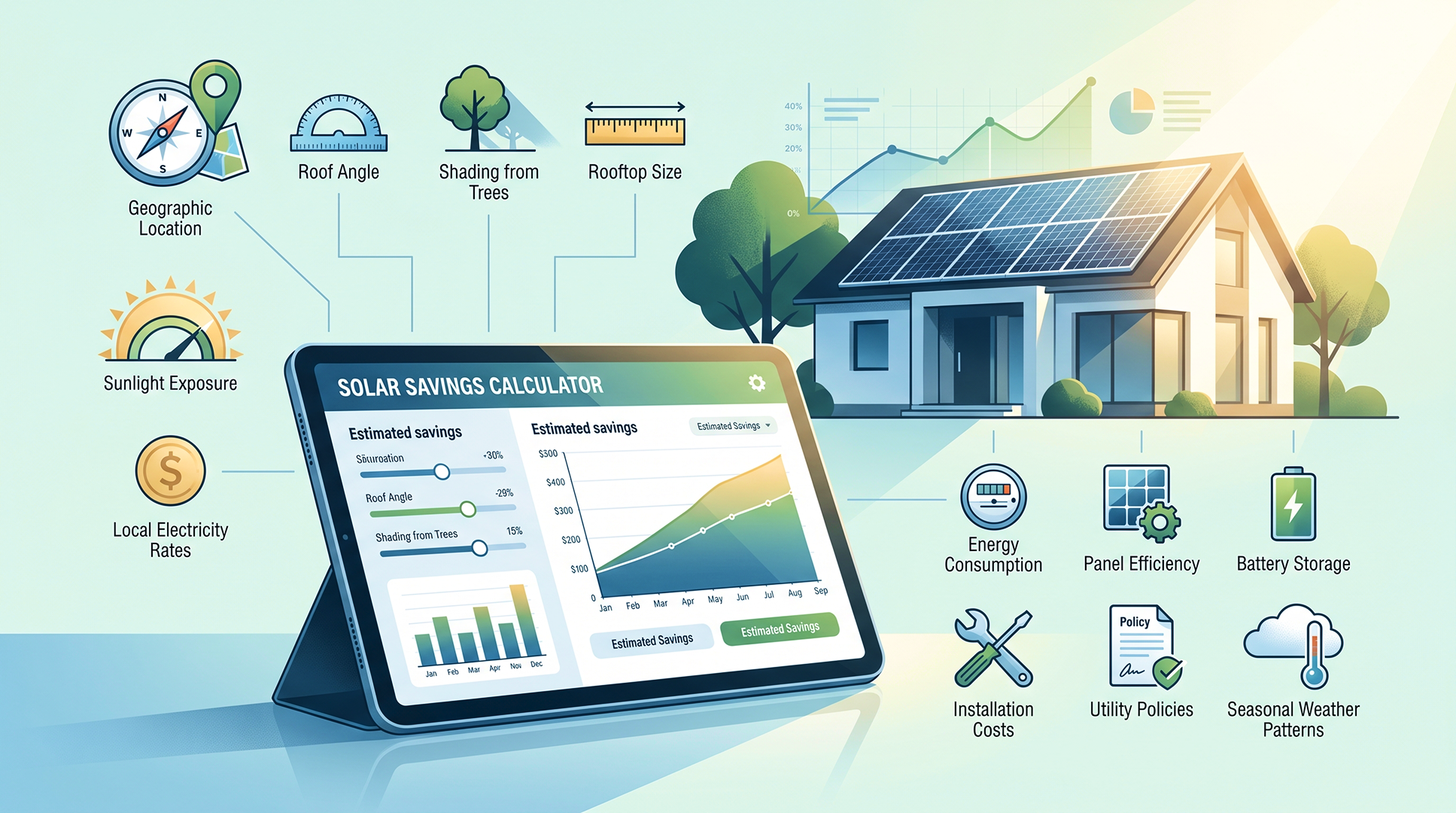
Household Electricity Usage and Local Utility Rates
Your electricity rate is the most powerful driver of solar savings in California.
According to the U.S. Energy Information Administration, California's residential rate reached 35.25¢ per kWh in April 2026 — nearly double the national average of 18.83¢ per kWh. That gap means every kilowatt-hour your solar system produces and consumes on-site delivers roughly twice the savings it would in most other states.
The EIA's most recent full-year data shows California households paid an average monthly bill of $160.86 in 2024, and 2026 rates are pushing that figure higher. How much higher depends on your utility — customers served by PG&E, SCE, SDG&E, or LADWP each face different rate structures, which is why your specific utility provider directly shapes what solar can save you.
Roof Orientation and Billing Rules
Roof orientation and pitch matter significantly too.
South-facing roofs generate the most solar energy across a full year, but west-facing panels have become increasingly valuable under California's NEM 3.0 net billing policy. Under NEM 3.0, which applies to all new residential installations after April 2023, utilities pay only about 5 to 8 cents per kilowatt-hour for electricity you export to the grid — a fraction of the 30 to 35 cents you pay to draw power.
West-facing panels produce electricity later in the afternoon, when grid demand peaks and when you would otherwise pay the highest time-of-use rates, so more of that production gets consumed directly at its full value.
Since orientation, pitch, and shading vary from property to property, estimates based solely on ZIP code averages routinely miss what your specific roof can actually generate.
Why Most Solar Calculators Get It Wrong
The problem with most online solar calculators is not the arithmetic. It is the inputs. Generic calculators frequently rely on assumptions such as:
Average ZIP code electricity consumption
Standard roof orientation
Average sunlight hours
Typical equipment efficiency
General utility rates
A ZIP-code-based tool assumes an average roof in your general area. It cannot see whether your roof runs north-to-south or east-to-west, whether a mature tree shades your south-facing slope for three hours each morning, or whether your household uses 750 kilowatt-hours a month rather than the regional average of around 500.
These assumptions can result in estimates that differ drastically from your actual experience. Still and all, a good calculator should answer the most pressing question: How much can solar save me specifically, and not the average homeowner two streets over? Getting there requires more than an address.
RELATED READING: Curious what your estimated savings could translate into? Learn what California homeowners typically pay for solar panels, batteries, and installation in 2026.
How SunEstimate Calculates Your Savings
One of the biggest differences between a basic online calculator and a more advanced solar energy savings tool lies in the quality of the underlying data.
Rather than relying primarily on statewide averages, SunEstimate analyzes several property-specific factors that significantly improve estimate accuracy. These include roof-level sunlight analysis, actual household energy usage, intelligent system matching, and instant proposal generation based on the home's characteristics.
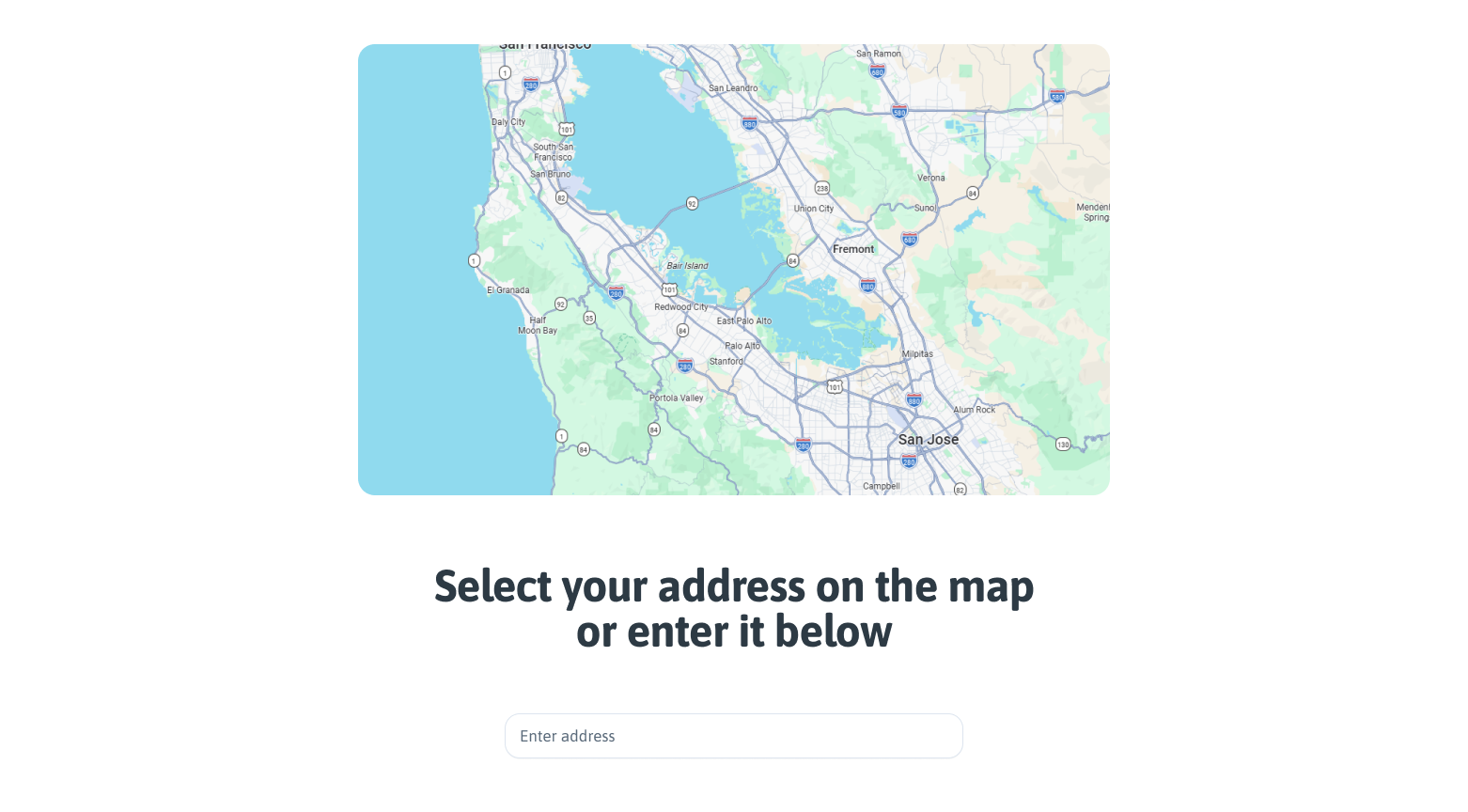
When you enter your address, the calculator pulls roof and sunlight data from Google Maps Platform and analyzes your specific home — the usable space your roof has, the direction and pitch of each surface, and where shade falls across different times of day and different seasons. That geometric detail is what most standard calculators replace with a regional average.
The second step focuses on your energy use rather than a household profile. SunEstimate asks for your actual monthly electricity consumption and what you pay, then sizes a recommended system around those real numbers.
A personalized proposal you receive includes the recommended system size and equipment configuration, battery storage options with reasoning for whether a battery helps your specific situation, total cost alongside any applicable incentives, estimated annual production, and a long-term savings range with a payback period.
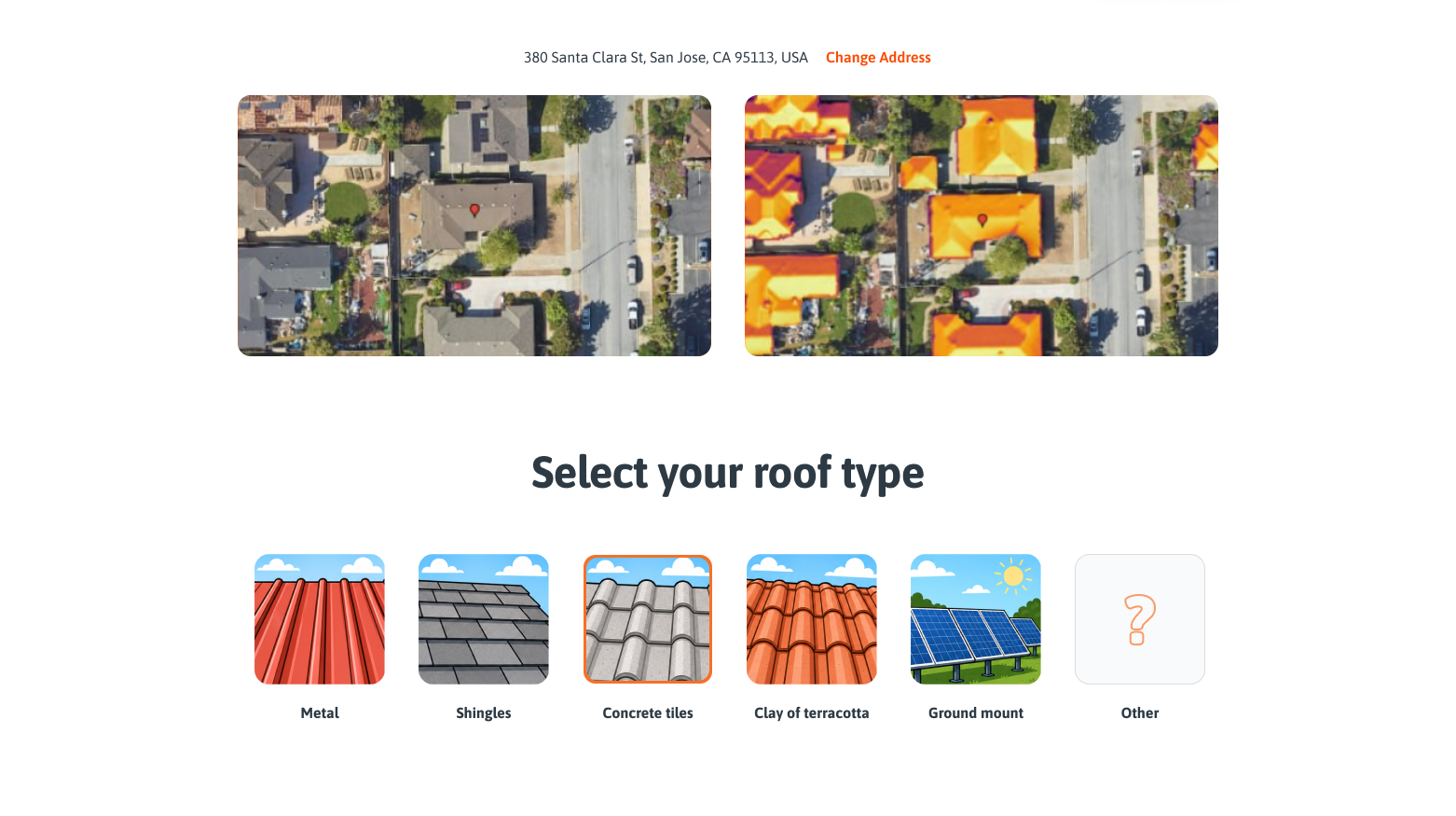
After calculating production, the platform automatically matches the home with appropriately sized equipment and generates a personalized proposal, helping homeowners understand not only potential savings but also recommended system specifications.
You can calculate your solar savings and review the complete estimate at your own pace, with no sales call triggered until you ask for one.
How to Read and Use Your Results
Once you have an estimate, a few numbers carry the most weight.
The annual savings figure tells you how much the system is projected to reduce your electricity bill in a typical year. Treat it as a range rather than a fixed number, because solar production varies with weather, your usage will shift over time, and electricity rates affect the value of every kilowatt-hour your system produces.
The payback period shows when your cumulative savings equal your net system cost. California solar payback periods currently range from roughly 5 to 10 years, depending on your utility territory, whether you add battery storage, and local installation pricing.
The long-term savings projection is worth as much attention as the payback period. Solar panels carry warranties of 25 years or more, and California electricity rates have shown a clear long-term upward trend. A system that pays back in nine years still delivers more than fifteen additional years of bill savings.
These numbers also point toward your next decision: whether a larger system or battery storage changes the picture for your household — which is exactly what a property-specific calculator can help you work out.
RELATED READING: Your savings depend on having the right-sized system. Learn how many solar panels your California home may need and what determines the ideal system size.
Conclusion: Start with a Personalized Estimate
I always say the best time to get informed about solar is before anyone is trying to sell it to you. The calculator is where that starts.
California homeowners carry one of the highest electricity cost burdens in the country. The case for solar is still genuine — but only if the estimate you are working from reflects your actual roof, your actual bill, and the way California utilities work in 2026. An estimate built on ZIP code averages will give you a number. But it won’t necessarily give you the right one.
When you are ready to see what solar actually looks like for your home, get a personalized solar estimate for your home and walk into your first installer conversation with your own numbers already in hand.
--
Quick Answers
How accurate is a solar savings calculator?
A solar savings calculator can provide a useful estimate, but its accuracy depends on the data it uses. Calculators that analyze a home's actual roof, sunlight exposure, and real electricity consumption generally produce more reliable results than those based only on ZIP code averages.
How much can solar save me on my electricity bill?
Savings vary from one household to another depending on electricity usage, local utility rates, system size, and available sunlight. A personalized estimate provides a much more accurate projection than a statewide average.
Does the calculator include battery storage?
Some calculators estimate only the performance of solar panels, while others also evaluate battery storage. Because California's current net billing rules (NEM 3.0) reward using more of your own solar energy, including battery storage can provide a more complete picture of potential savings.
Can a solar calculator tell me exactly what my system will cost?
No. A calculator provides an estimate based on available information. Final pricing depends on factors such as equipment selection, roof complexity, permitting, labor, and installer proposals.
What is the solar payback period in California?
California payback periods currently range from roughly 5 to 10 years, varying by utility territory, system design, and whether battery storage is included.