
 Back to blog
If you're researching the cost of solar panels in California 2026, you're probably trying to answer one simple question: Is solar actually worth it for my home?
The short answer is that solar remains one of the most effective ways California homeowners can reduce long-term electricity costs. However, installation prices vary significantly based on system size, roof characteristics, location, equipment choices, and whether battery storage is included.
Understanding those variables can help you avoid surprises and make more informed decisions. This guide walks you through real, sourced figures so you know what to expect before you ever talk to a salesperson.
Key Findings Summary
Average solar cost: $2.50–$3.20 per watt before incentives.
Typical system cost: $20,000–$28,000 before incentives.
Average system size: 7–9 kW.
Battery storage: Adds approximately $11,800–$16,100.
Payback period: Around 8 years.
NEM 3.0: Batteries are increasingly valuable.
ITC: Federal residential solar tax credit expired after 2025.
Average Cost of Installing Solar Panels
As of June 2026, California remains one of the most active residential solar markets in the United States, slightly above the national average in terms of cost. This is mostly due to the state's higher labor costs compared to other places. However, California also has some of the highest electricity rates in the country, which makes going solar worthwhile.
According to Energy Sage marketplace data, the average installed residential solar system costs approximately $2.53 per watt, while Solar Reviews reports a statewide average closer to $3.33 per watt.
That range matters more than the average. Two homes on the same street can get different quotes because of roof complexity, panel choice, and which installer they pick. As a quick rule of thumb, you can multiply your system size by the cost per watt to ballpark a price. The following is a typical pricing range before incentives, which depends on the system's capacity:
5 kW: $12,500–$17,000
7 kW: $17,500–$24,000
8 kW: $20,000–$27,000
10 kW: $25,000–$32,000
These estimates include equipment, permitting, design, labor, and installation but can vary based on site-specific conditions.
Understanding Cost Per Watt
Cost per watt is the most useful metric for comparing quotes because it accounts for differences in system size. For example, if one installer quotes a 7-kW system and other quotes a 9-kW system, comparing the total prices tells you little. In contrast, comparing dollars per watt tells you who's actually cheaper.
In California, homeowners typically see installed pricing between $2.50 and $3.20 per watt in 2026. Lower prices may reflect highly competitive markets or larger systems, while higher prices often involve premium equipment, difficult roof conditions, or battery integration.
For example:
A 7-kW system at $2.50/W would cost roughly $17,500.
A 7-kW system at $3.20/W would cost roughly $22,400.
Comparing multiple proposals remains one of the most effective ways to understand where your property falls within that range.
What Affects the Price of Going Solar
No two homes receive identical solar quotes. Several factors influence pricing:
System Size. This is the biggest driver. A larger system produces more power but costs more upfront — though bigger systems often have a slightly lower cost per watt because of bulk pricing.
Equipment quality. Higher-efficiency panels and premium inverters cost more. At the same time, panels with higher power output often require more expensive microinverters to handle that output. Cheaper panels might save a few hundred dollars on the total installation.
Roof complexity. A simple, south-facing asphalt roof is cheap to work with. Steep pitches, multiple levels, tile roofs, or shading all add labor and cost. If your roof needs repairs first, budget extra.
Energy use. The more electricity you use, the larger the system you need. Your past 12 months of utility bills are the single best predictor of the right system size.
Utility and interconnection requirements. Requirements from utilities such as Pacific Gas and Electric Company (PG&E), Southern California Edison (SCE), San Diego Gas & Electric (SDG&E), and Los Angeles Department of Water and Power (LADWP) can influence project timelines and overall costs.
Location and installer. Labor rates, permitting timelines, and local competition all shift the final number — which brings us to the regional picture.
California Solar Panel Prices: City Breakdown
Solar prices can vary depending on local labor markets, utility rates, permitting processes, and sunshine levels.
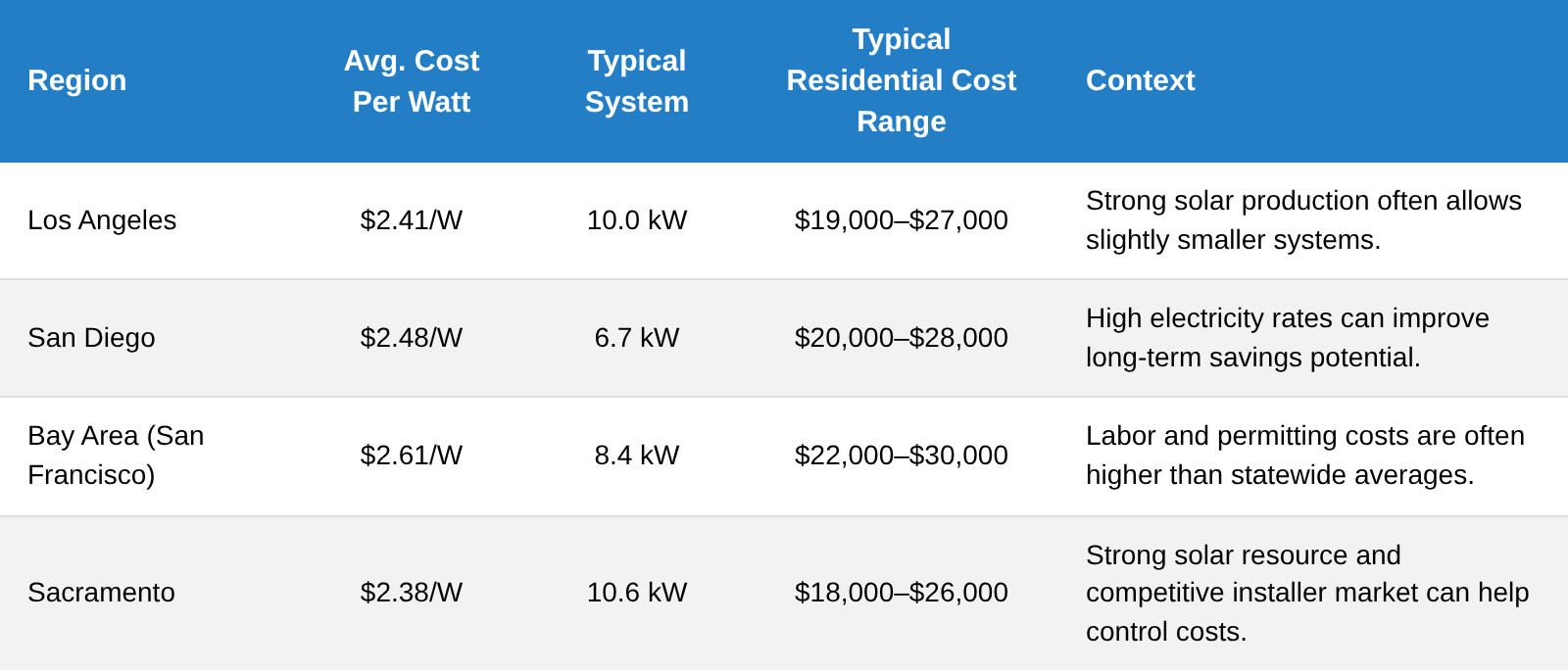
These ranges reflect typical residential systems and regional market conditions rather than fixed pricing.
If you want to calculate your solar savings, use the Sun Estimate advanced estimator to see your personalized estimate based on your roof, actual energy usage, and location.
Solar Battery Storage Add-On Costs
While batteries increase upfront costs, they can help homeowners store excess daytime solar production and use it during expensive evening utility periods. This reduces reliance on grid electricity and can improve overall savings under California's current net billing framework.
The average residential battery system in California costs approximately $11,864–$16,052, with an average gross price of $13,958 before incentives.
Why does storage matter so much now? Under the Net Energy Metering 3.0 (NEM 3.0) policy, the credit you earn for exporting solar to the grid dropped sharply. Net Billing pays roughly $0.08 per kWh on average for exports, versus the $0.30–$0.35 retail rates under the old NEM 2.0 — about a 75% reduction. A battery lets you store cheap daytime solar and use it during expensive evening hours instead of selling it back for pennies.
Adding storage makes the most financial sense if you're on one of the major investor-owned utilities (PG&E, SCE, SDG&E), if you experience frequent outages, or if you qualify for battery rebates. Solar-plus-storage systems improve overall economics by 20–40% compared to solar-only configurations under NEM 3.0.
Solar Incentives Available in California
This is where 2026 looks different from prior years. California no longer offers many of the broad residential solar incentives that helped drive early adoption. However, homeowners may still benefit from several programs.
Federal tax credit — expired. The 30% residential federal solar tax credit (the Residential Clean Energy Credit, Section 25D) is no longer available for homeowner-owned systems. Under IRS guidance, an expenditure is treated as made when installation is completed, and if installation is completed after December 31, 2025, the taxpayer cannot claim the Section 25D credit.
In plain terms: if you buy your system with cash or a loan in 2026, do not count on a federal credit. (Leases and PPAs follow different commercial rules, where the system owner may pass savings through to you — worth asking installers about if that's your path.)
NEM 3.0. Not a rebate, but a policy that shapes your savings. Under NEM 3.0, the solar buyback rate averages about a quarter of the retail rate and changes during every hour of the day. This is the single biggest reason batteries have become standard.
SGIP battery rebate. California's Self-Generation Incentive Program offers rebates specifically for storage. Standard-tier SGIP provides around $200 per kWh of battery capacity, while the Equity Resiliency tier for low-income households in high-fire-risk areas can reach up to $1,000 per kWh. Funding and tiers shift, so check current availability.
Property tax exclusion. Adding solar won't raise your property tax assessment. California's Proposition 13 exclusion protects solar installations from property tax assessment. On a typical system that's meaningful savings over 25 years.
Prepaid PPA. A Prepaid Power Purchase Agreement (PPA) allows the homeowner to make a one-time upfront payment for the electricity the solar system is expected to generate over the agreement term, typically 20 years. In return, the homeowner benefits from lower, more predictable energy costs over time.
Solar Payback Period and ROI
Even without the federal credit, California's high electricity rates keep solar a strong investment. The key metric is the solar payback period — how long until your energy savings cover the system's cost.
For most California homeowners with a battery, payback lands in the range of 6 to 11 years, depending heavily on your utility. SDG&E customers with batteries typically see the fastest payback at 6–8 years due to extremely high electricity rates, while PG&E and SCE customers with batteries average 8–10 years. Solar-only systems under NEM 3.0 take longer — often 11 years or more — which is another reason storage tends to improve the overall return.
Once you've recouped your initial investment, the electricity your system produces is essentially free for the rest of its 25–30-year lifespan. This is where the long-term savings really add up. As California utility rates continue to climb, the bills you avoid typically grow over time.
Conclusion: Find Your Real Number
Solar panel prices in California in 2026 are more predictable than most homeowners expect — generally $2.40 to $3.15 per watt, with a typical system around $22,000 before incentives and a battery adding roughly $12,000 to $16,000
The only number that truly matters, though, is the one for your home. Skip the guesswork and the high-pressure sales pitch: use Sun Estimate to get a personalized solar estimate for your home, built around your actual roof, energy use, and utility — so you can make the call with real data in hand.
--
Quick Answers
How much do solar panels cost in California in 2026?
Most homeowners can expect residential solar systems to cost approximately $20,000–$28,000 before incentives, depending on system size and equipment choices.
What is the average solar cost per watt in California?
Most installations fall between approximately $2.50 and $3.20 per watt installed.
Is solar still worth it under NEM 3.0?
For many homeowners, yes. However, battery storage has become increasingly important because exported electricity is compensated at lower rates than under previous net metering rules.
How much does a solar battery cost?
Most residential battery installations cost approximately $11,800–$16,100, depending on storage capacity and equipment selection.
How long does it take solar to pay for itself?
Many California homeowners see payback periods near eight years, though actual results vary based on utility rates and household consumption patterns.