
 Back to blog
It's one of the first questions homeowners ask when exploring solar energy.
While there is no one-size-fits-all answer, most California homes require somewhere between 14 and 24 panels to offset a large portion of their annual electricity usage.
In today's blog, we'll delve into the key factors that influence the size of a solar panel system for a home in California: energy usage, panel production in your region, and methods to estimate the appropriate system size for your property.
Key Findings Summary
Typical panel count: 14–24 panels.
Typical system size: Approximately 6–10 kW.
Average panel wattage: Typically 400–450W.
Biggest sizing factor: Household electricity usage.
California advantage: Strong solar production potential.
Best estimate: Property-specific analysis.
What Determines How Many Solar Panels You Need
Three numbers drive virtually every solar sizing calculation: your annual electricity consumption, the wattage of the panels you’re installing, and your location’s production ratio.
Annual electricity consumption is the starting point. Pull twelve months of utility bills and add up the total kilowatt-hours. That figure, not your home’s square footage, is the most accurate input.
Panel wattage determines how much each panel contributes. Most residential installations in 2026 use panels rated between 400 and 450 watts, with 400–430 W being the most common range quoted by installers. Higher wattage reduces the total number of panels needed—useful when roof space is limited.
Production ratio accounts for how much electricity your system will actually generate relative to its rated capacity. It rolls in sun hours, roof orientation, shading, and system losses. California production ratios typically fall between 1.4 and 1.6, meaning a well-sited 6 kW system here might produce 8,400–9,600 kWh annually.
The formula installers use:
Annual kWh ÷ (Production Ratio × Panel Wattage in kW) = Number of Panels
For example, a home using 7,200 kWh per year (600 kWh/month), with 430-watt panels and a 1.5 production ratio: 7,200 ÷ (1.5 x 0.43) = approximately 11 panels.
Average California Home Energy Usage
The U.S. Energy Information Administration’s 2024 residential data puts California’s average monthly consumption at 503 kWh—roughly 6,036 kWh annually. That’s the lowest figure among the contiguous 48 states, driven largely by the state’s mild coastal climate and long-standing efficiency standards.
In practice, a 503 kWh average masks wide variation. A single-person apartment in San Francisco might use 300–400 kWh per month. A four-bedroom house in Fresno with central AC, an electric vehicle, and a pool can easily exceed 1,200 kWh. Where you fall in that range matters more than the statewide figure.
Factors that push California homes toward higher consumption: inland locations with hot summers where AC runs from May through October; electric vehicles, which typically add 200–400 kWh per month; pool pumps and heaters; electric water heating or heat pumps; and larger homes, where square footage correlates with consumption even if it isn’t a direct sizing input.
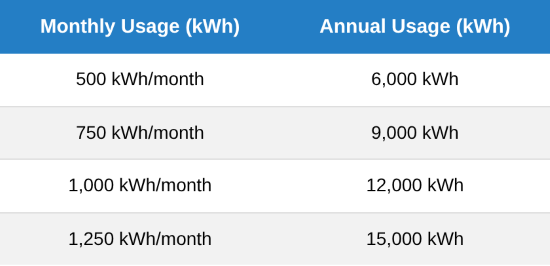
Many California homes fall within these general ranges:
How Panel Wattage Affects the Panel Count
Another major factor is solar panel wattage. It has climbed steadily. A system that would have needed 20 panels at 300 W five years ago can now be built with 14 panels at 430 W—covering the same annual output in roughly 30% less roof space.
Standard residential panels in 2026 fall in the 400–450 W range. High-efficiency models push toward 450–500 W. The higher the wattage, the fewer panels required, though individual panel cost increases. For most California homeowners, 400–430 W panels represent the practical midpoint between cost and roof-space efficiency.
For example:
A 7.2 kW system using 400-watt panels requires approximately 18 panels.
A 7.2 kW system using 450-watt panels requires approximately 16 panels.
The difference between a 400 W and 430 W panel may sound small, but across a 14-panel system it amounts to roughly 420 additional watts of capacity—nearly an extra panel’s worth of output without adding a physical panel.
Local Factors: Region, Sun Hours, and Roof Conditions
California averages approximately 5.4 peak sun hours per day statewide, according to NREL’s (National Renewable Energy Laboratory) PVWatts data. But that average is almost useless for system sizing because the variation across the state is substantial.
Inland areas—Sacramento, Fresno, the Inland Empire, and the Central Valley—typically receive 5.5–6.0 peak sun hours per day. Southern coastal areas like Los Angeles and San Diego average 5.5–5.8. The San Francisco Bay Area and coastal Northern California tend to fall between 4.5 and 5.2, largely due to marine layer and fog patterns.
A home in Sacramento and a home in San Francisco with identical consumption will need different system sizes. The Sacramento home, receiving more peak sun per day, can generate the same annual output with one or two fewer panels.
Roof conditions shape real-world output as much as geography. South-facing roofs at a 20–35 degree pitch capture the most solar energy in California. East- and west-facing roofs typically require 10–20% more panels to match the output of a south-facing array.
Significant shading from trees or neighboring structures can reduce system production by 10–30%, requiring a larger array to compensate. Roof age and material also matter: some installers won’t mount on roofs with fewer than ten years of expected remaining life.
Before committing to any panel count, find out how many panels your home needs using a tool that accounts for your specific address, roof orientation, and local irradiance data.
Estimated Panel Counts by Electricity Usage
The table below shows estimated panel counts for four common monthly consumption levels across California homes. Estimates assume 430-watt panels, a production ratio of 1.5 (typical for central/southern California), and 100% consumption offset. Coastal homes with lower sun hours may fall toward the higher end of each range; inland homes toward the lower end.
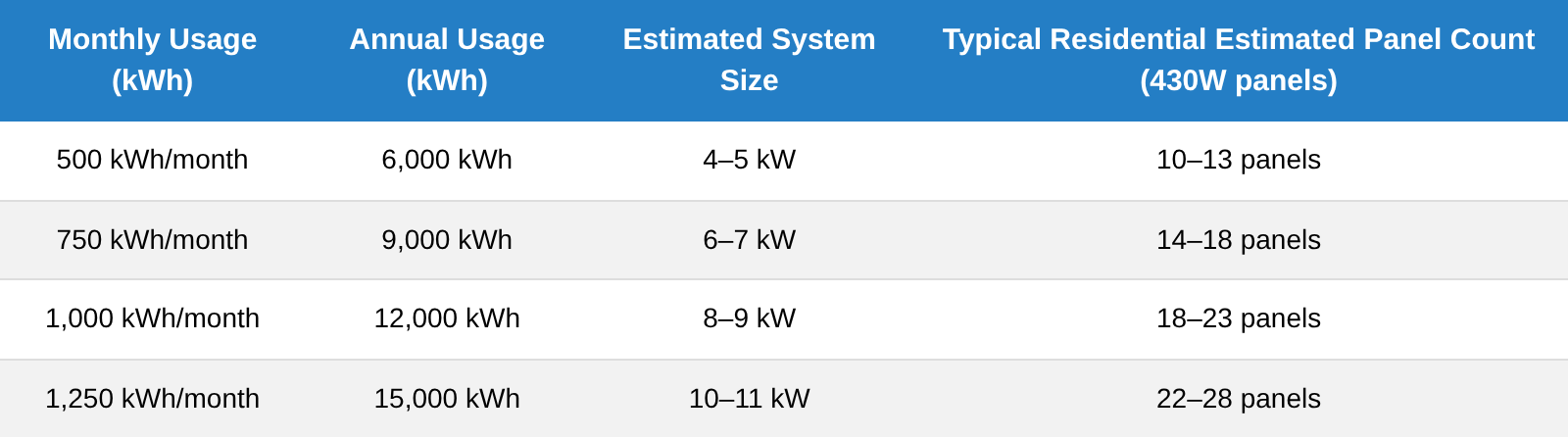
These ranges align with production assumptions commonly used by NREL's PVWatts methodology and current California residential solar installations.
NOTE: Planning to add an EV or heat pump? Budget an additional 3,000–4,500 kWh per year for an electric vehicle, depending on driving habits. A heat pump water heater adds roughly 1,500–2,000 kWh annually. Factor these into your consumption before sizing to avoid undershooting the system.
Typical Panel Counts by Home Size
Many homeowners ask how many panels are needed based on square footage.
While home size can provide a rough estimate, electricity usage remains a more accurate sizing method because two homes with identical square footage may consume vastly different amounts of electricity.
Nevertheless, typical California homes often fall into these ranges:
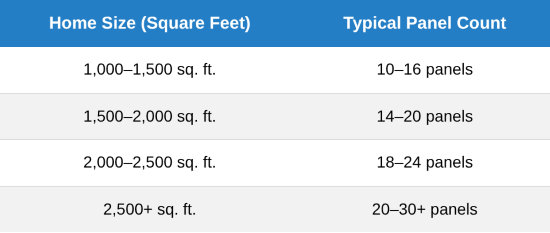
These estimates assume average energy consumption patterns and modern high-efficiency panels.
NOTE: Once you have a rough idea of how many panels you need, the next step is to understand the investment. See our guide, "How Much Do Solar Panels Cost in California in 2026?" for current pricing, battery costs, incentives, and payback expectations.
The Bottom Line: How to Get an Accurate Count for Your Home
When you raise the question, "How many solar panels do I need?" the answer does not depend solely on home size or geography, but rather on consumption. Instead of relying on generic assumptions, homeowners should review property-specific calculations before making decisions.
Tools like Sun Estimate analyze property-level information to generate personalized estimates. These estimates help you determine the ideal number of panels, projected energy production, potential savings, and overall return on investment.
The best part? The process takes minutes and saves you from over- or underbuying when installer quotes arrive.
--
Quick Answers
How many solar panels do I need for a typical California home?
Most California homes using 500–700 kWh per month require approximately 14–24 solar panels rated at 400–430 watt. Homes with higher consumption, EVs, or pools may need 20 panels or more.
Does panel wattage affect how many panels I need?
Yes. A 430-watt panel produces about 7.5% more output than a 400-watt panel. Across a 14-panel system, that difference is nearly equivalent to an additional panel’s worth of capacity. Higher-wattage panels cost more per unit but reduce total panel count and installation labor.
How does my location in California affect system size?
Inland areas like Sacramento, Fresno, and the Inland Empire average 5.5–6.0 peak sun hours per day, while coastal areas like San Francisco often see 4.5–5.0. A home in Fresno may need one to two fewer panels than an identical-consumption home in San Jose.
Does roof size determine how many panels I need?
Roof size can limit how many panels can be installed, but electricity usage remains the primary factor used to determine system size.
Should I size my system for current or future usage?
Plan for future loads if an EV, heat pump, or pool is on the horizon within two to three years. Under NEM 3.0, oversizing beyond your consumption still adds costs without proportional savings, so aim to size for your anticipated peak demand rather than excess.